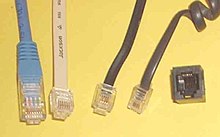
 Cords connecting to an RJ11 interface require a 6P2C connector. Nevertheless, cords sold as RJ11 often use 6P4C connectors (six position, four conductor) with four wires.
 Understand the key differences between RJ11, RJ14, RJ45, and RJ48 connectors, including pinouts, wiring, applications, and data transmission capabilities.
 RJ11 is the most widely-used registered jack in telecommunications. RJ11 has a 6P2C or 6P4C configuration, and is used for wiring a single phone line. RJ45 uses an 8P8C configuration.